 JapanMachineryTrader
Japan’s rental companies replace their fleets on strict cycles, often after just a few thousand hours. That creates a steady supply of used excavators for sale Japan that are well-maintained, lightly worked, and priced well below what you’d pay for equivalent machines elsewhere. For contractors and equipment buyers in Africa, the Middle East, Southeast Asia, and beyond, this is one of the most cost-effective ways to source reliable machinery.
The challenge? Buying from the other side of the world comes with real risks. You need to verify machine condition, navigate export paperwork, arrange international shipping, and avoid the kind of costly mistakes that can turn a good deal into a headache. Without a clear process, it’s easy to get stuck or worse, end up with a machine that doesn’t match what was advertised.
That’s exactly what this guide covers. From choosing the right excavator and understanding inspection reports to handling logistics and customs, we’ll walk you through each step of buying and shipping used excavators from Japan. At Japan Machinery Trader, we source equipment directly from Japanese rental fleets and auction channels, inspect every machine, and handle the export process, so we’ve built this guide around what actually matters when you’re spending real money on equipment from overseas.
What to know before you shop in Japan
The Japanese used equipment market works differently from what you might expect. Rental companies in Japan replace machines on fixed schedules regardless of condition, which means the used excavators for sale Japan market consistently supplies machines with lower hours and better maintenance records than you’d typically find at local auctions in your home country. Understanding how that supply chain works helps you buy smarter and avoid the common traps that catch out first-time international buyers.
How Japanese rental fleets create reliable stock
Japanese rental companies operate under strict maintenance schedules and rarely push machines past their rated capacity. Most excavators leaving these fleets have between 2,000 and 5,000 working hours on the meter, well below the threshold where major component wear becomes a serious concern. When you see a machine listed with a detailed service record and a low hour count, it’s usually because a rental company maintained it to stay leasable, not because someone has been selective about what they’re telling you.
Machines sourced directly from Japanese rental fleets typically have more useful life remaining than comparable used equipment from other markets, which directly affects your total cost of ownership over the machine’s working life.
The two main buying channels
You can source used excavators from Japan through two main channels: auction houses and direct exporters. Auction houses like USS, JU, and HAA run weekly sales where thousands of machines are graded and sold quickly. Inspection sheets are standardised, but you need local knowledge to bid correctly, and the pace of auction sales leaves little room for follow-up questions before the hammer falls.
Direct exporters source stock from those same auctions and rental companies, then inspect and list machines with full condition reports. This second route typically costs a little more upfront, but gives you far more control, clearer documentation, and a direct contact who can answer questions before you commit money.
What documents to expect
Every legitimate export from Japan should come with a specific set of paperwork, and asking for this list upfront is one of the easiest ways to test whether a seller knows what they’re doing. Confirm you’ll receive all of the following before you pay any deposit:
- Vehicle export certificate – the Japanese deregistration document required to legally export the machine
- Bill of lading – issued by the shipping line confirming the goods are on board
- Commercial invoice – shows the transaction value for customs purposes
- Packing list – details the contents of the shipment
- Certificate of origin – required by customs authorities in most destination countries
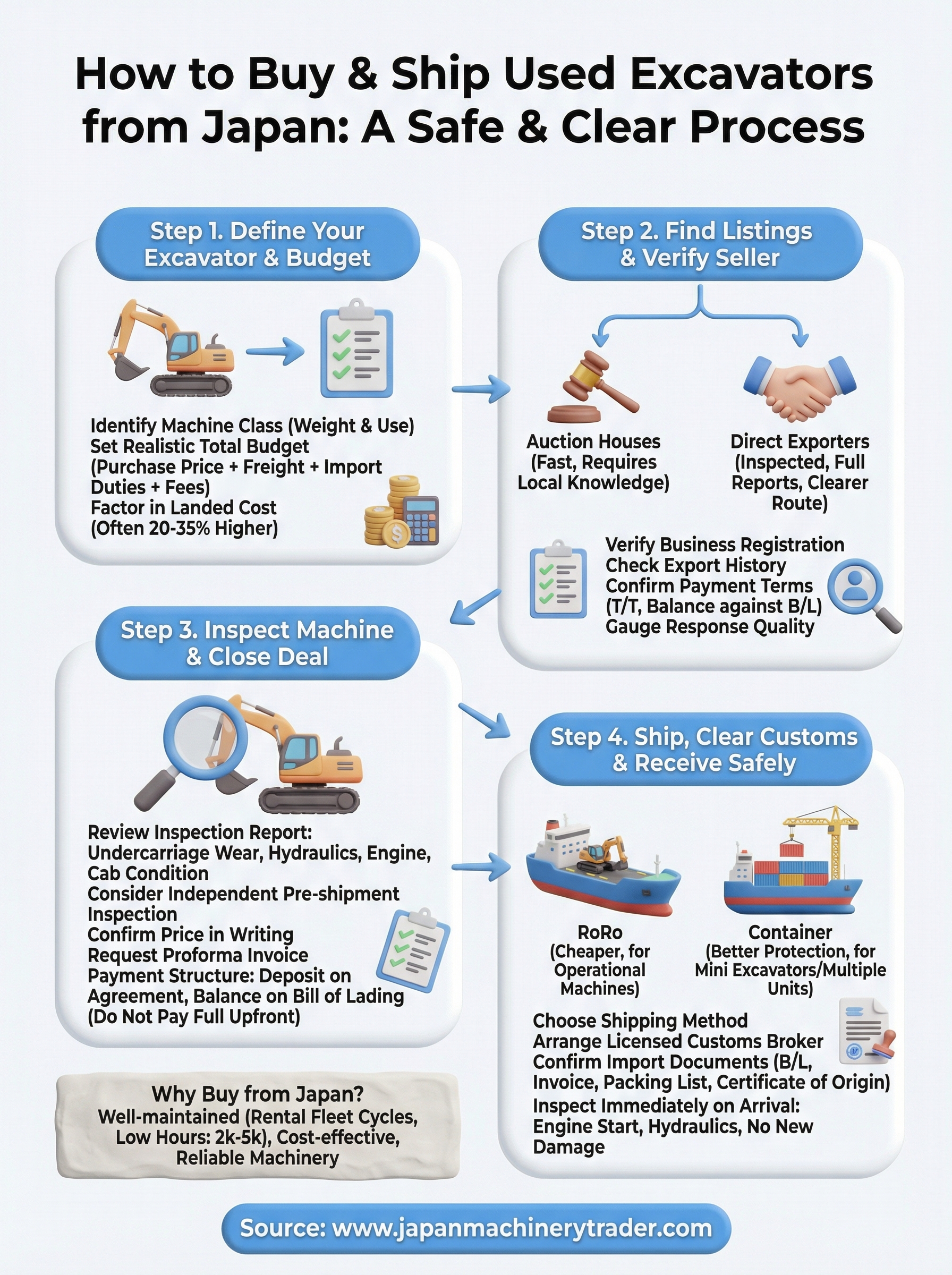
Step 1. Define the right excavator and budget
Before you browse any listings, nail down exactly what you need. Buying the wrong class of machine is one of the most common and expensive mistakes buyers make when sourcing used excavators for sale Japan. A clear specification and a realistic total budget before you start shopping will save you weeks of back-and-forth with sellers.
Choose your machine class
Your job site conditions and the tasks you need to complete determine which class of excavator fits your work. Use this table as a starting point:
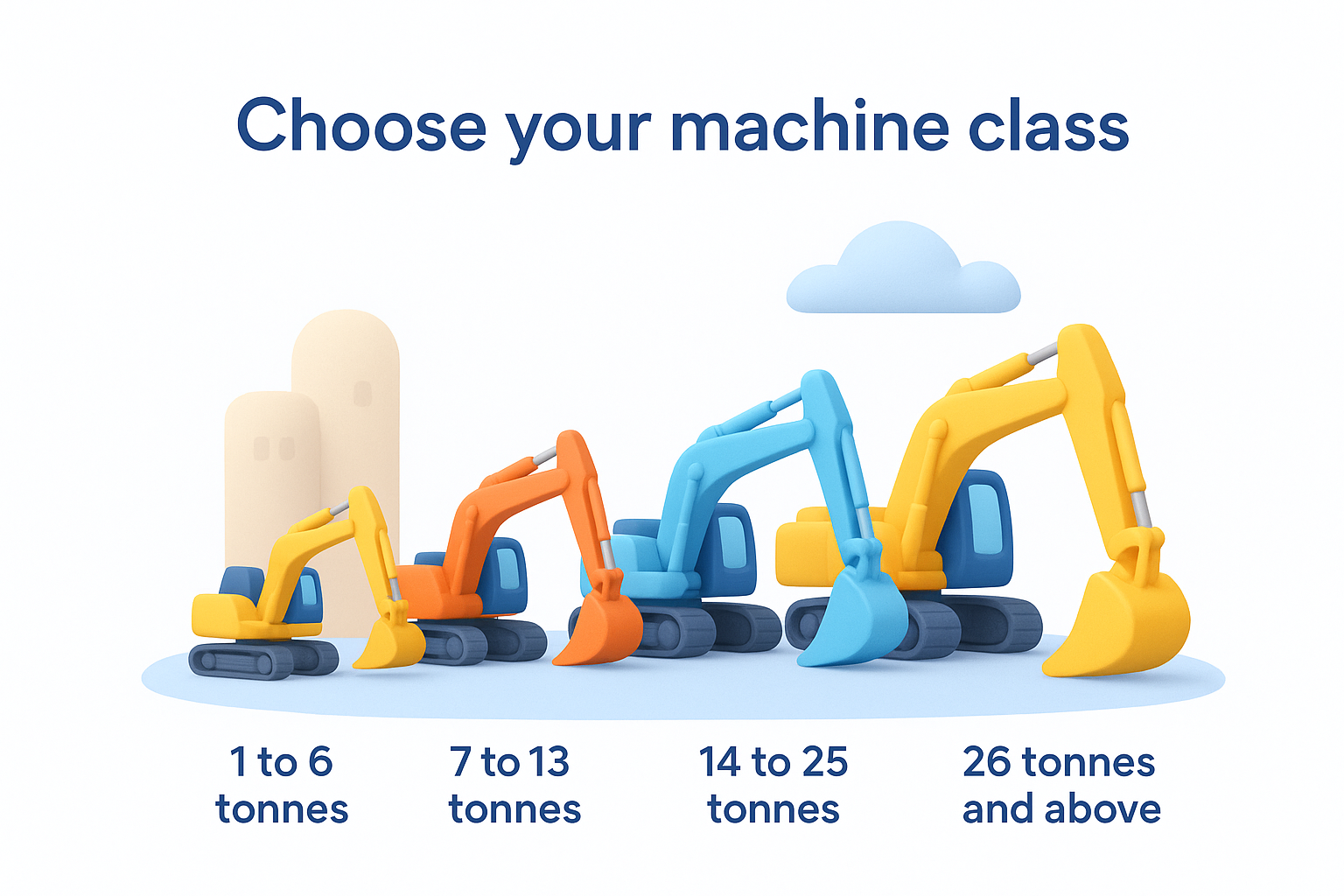
| Machine class | Operating weight | Typical use |
|---|---|---|
| Mini excavator | 1 to 6 tonnes | Tight urban sites, landscaping, trenching |
| Small excavator | 7 to 13 tonnes | General civil works, utility installation |
| Mid-size excavator | 14 to 25 tonnes | Road building, foundation work |
| Large excavator | 26 tonnes and above | Mining, quarrying, heavy earthworks |
Brands like Komatsu, Hitachi, and Kubota are well-represented in the Japanese rental market across all these classes, so availability is generally strong regardless of your preferred make.
Set your total budget, not just the purchase price
The purchase price is only one part of your actual cost. Factor in every outgoing before you commit to a figure:
- Machine purchase price
- Pre-shipment inspection fee (if using a third-party inspector)
- Freight cost to your nearest port
- Import duties and taxes in your destination country
- Port handling and inland transport fees
Getting a landed cost estimate before you negotiate the machine price gives you a clear ceiling and prevents budget overruns at the final stage.
A realistic landed cost is often 20 to 35 per cent higher than the ex-Japan price depending on your destination, so build that buffer into your figures from the start.
Step 2. Find listings and verify the seller
Once you have your specification and budget confirmed, the next task is to find actual available stock and confirm the seller is credible before you send any money. The used excavators for sale Japan market includes legitimate exporters alongside people who list machines they don’t yet own or can’t deliver on schedule. A few targeted checks upfront will separate trustworthy sellers from the ones to avoid.
Where to find legitimate listings
Dedicated Japanese equipment exporters maintain updated stock lists with full specifications, operating hours, and condition reports. Look for listings that include the hour meter reading, photos of the undercarriage and cab, and a breakdown of any defects noted during inspection. Generic listings with only one or two photos and no condition detail are a red flag that the seller is reselling without inspection or working from auction preview images.
A good listing should show at minimum:
- Hour meter photo confirming the reading shown in the specification
- Multiple photos covering the cab interior, undercarriage, and any damaged or repaired areas
- Written condition notes on worn components or recent repairs
How to verify the seller
Run through this checklist before you move to negotiation:
A credible exporter will always be able to tell you exactly where the machine is sitting, when it was last inspected, and which port it will ship from.
- Business registration: Ask for the company’s registered business name and country of incorporation. A real exporter operates a legal entity.
- Export history: Ask how many machines they have shipped to your region and whether they can connect you with a past buyer.
- Payment terms: Legitimate sellers accept telegraphic transfer (T/T) with a clear deposit and balance structure tied to the bill of lading, not full payment upfront with no documentation.
- Response quality: A credible seller answers specific technical questions about the machine directly, without vague reassurances.
Step 3. Inspect the machine and close the deal
Inspection is where you confirm that what you’re buying matches what was advertised. For used excavators for sale Japan, you have two realistic options: rely on the exporter’s own condition report, or commission an independent pre-shipment inspection from a third-party agent based in Japan. If the exporter is well-established and provides detailed inspection sheets with clear photos, their report is often sufficient. If you’re spending significant sums or have any doubt about the seller, pay for an independent check.
How to read an inspection report
A solid inspection report covers more than just the hour meter and a few exterior photos. Key areas to assess include undercarriage wear percentage, hydraulic cylinder condition, cab interior, and any noted repairs or outstanding defects. Ask the seller to explain anything listed as a fault before you commit to a purchase price.
Use this checklist when reviewing a report:
- Undercarriage: wear percentage on track shoes and rollers (below 70% remaining is a negotiating point)
- Hydraulic system: leaks noted on cylinders or hoses
- Engine: oil condition, any smoke reported during test run
- Bucket and attachments: wear on cutting edge and pins
- Cab: seat condition, instrument panel faults, air conditioning function
A machine with minor noted defects and a transparent report is far more trustworthy than one with a perfect score and no supporting photos.
How to close the deal safely
Once you’re satisfied with the inspection, confirm the agreed price in writing and request a proforma invoice before transferring any funds. Your payment should follow a clear structure: a deposit on agreement, with the balance released against the bill of lading. Never pay the full amount before the shipping documents are in your hands.
Step 4. Ship, clear customs, and receive safely
Shipping is where many buyers lose control of the timeline and cost. Most used excavators for sale japan travel as roll-on/roll-off (RoRo) or container shipments, and the method you choose affects both cost and machine protection. Confirm the shipping method, vessel name, and estimated arrival date in writing before the vessel departs.
Choose the right shipping method
RoRo shipping is typically cheaper and works well for machines that are fully operational and correctly sized for standard vessel ramps. Container shipping offers better physical protection and is the better choice for mini excavators or when you need to consolidate multiple smaller items in one box. Ask your exporter to confirm which option suits your machine before you finalise freight costs.
| Method | Best for | Typical cost |
|---|---|---|
| RoRo | Standard excavators, operational machines | Lower |
| Container (20ft or 40ft) | Mini excavators, multiple units | Moderate to higher |
Clear customs at your destination
Your destination country’s import requirements will determine what documents customs needs on arrival. In most markets, you’ll need the bill of lading, commercial invoice, packing list, and certificate of origin to clear goods without delay. Working with a licensed customs broker in your destination country is the fastest way to avoid costly port storage fees while your paperwork is processed.
Confirm the import duty rate for your machine’s HS code before you finalise your total budget, not after the vessel arrives.
Receive and check the machine on arrival
Once the machine clears port, inspect it immediately against the pre-shipment report before signing any release paperwork. Note any damage that occurred during transit in writing and photograph it the same day, as shipping line liability claims have strict time limits. Check these items before the machine leaves the yard:
- Engine starts cleanly with no warning lights
- Hydraulics function across all circuits
- No new undercarriage or bodywork damage visible
Final checks before you buy
Before you commit funds, run through one last review. Confirm the machine specifications match your job site requirements, that you have a landed cost estimate covering freight, duties, and port fees, and that the seller has provided a proforma invoice with clear payment terms. If anything in the inspection report is unclear, ask for a written explanation before you pay a deposit. Vague answers at this stage are a reliable signal to walk away.
Sourcing used excavators for sale Japan through a specialist exporter simplifies every step in this guide. You get transparent inspection reports, documented export paperwork, and a single point of contact for shipping and logistics. When you know what to look for, buying from Japan is a straightforward process that consistently delivers well-maintained machinery at a competitive landed cost. Browse current stock and request a quote directly at Japan Machinery Trader.