
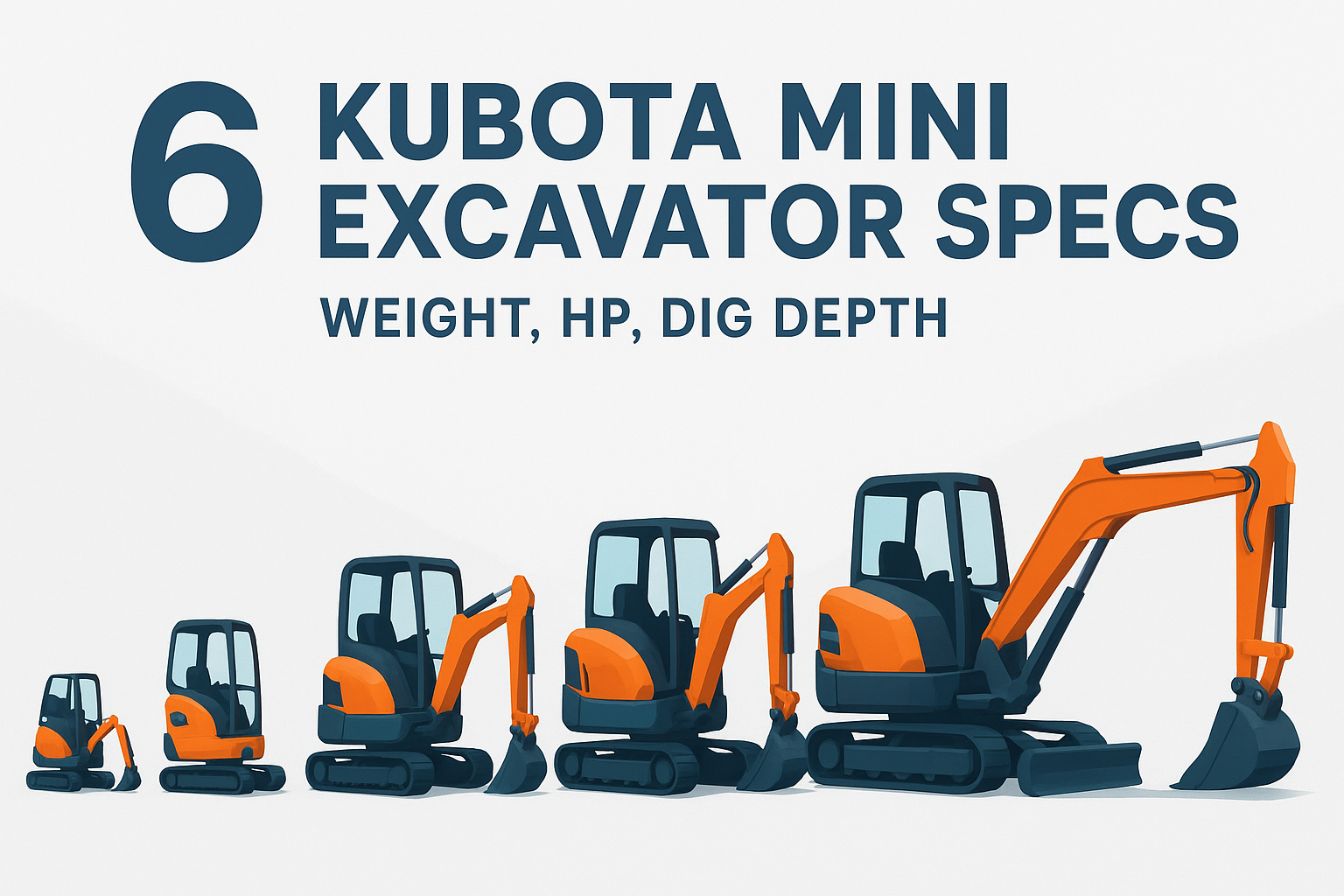
6 Kubota Mini Excavator Specs: Weight, HP, Dig Depth
Kubota builds some of the most popular mini excavators on the market — compact, fuel-efficient, and built to last well beyond their first owner. But choosing the right model means getting into the numbers: digging depth, operating weight, horsepower, and bucket capacity all vary significantly across the lineup, and those differences determine whether a machine fits your job or holds it back.
JMT Editorial TeamPublished April 21, 20267 min read
In this guide
Below is a breakdown of the specs for 6 Kubota mini excavator models, from the sub-1-ton K008-5 up to the KX057-5. Each section covers the key numbers — weight, horsepower, dig depth, and more — so you can compare models side by side and find the right fit for your operation.
How to Compare Specs Across Multiple Kubota Models Fast
When reviewing Kubota mini excavator specs across several models, line up the core numbers side by side: operating weight, engine horsepower, and maximum dig depth. Those three figures eliminate most mismatches immediately, whether your constraint is transport weight limits, site access width, or trench depth requirements. Narrowing by weight class first cuts your shortlist down faster than any other filter — start there, then work down to secondary specs once you've ruled out machines that clearly don't fit your jobsite conditions or haul capacity.
Once you have a shortlist, check bucket heaped capacity and hydraulic flow rate, which together determine how productive a machine is per cycle. You should also verify tail swing radius, especially when working in confined sites where a standard-swing machine creates safety risks near walls or structures. Auxiliary hydraulic flow is worth confirming if you plan to run attachments like hydraulic breakers or augers, since not all models in this lineup deliver the same output at the auxiliary circuit.
Ask for the full inspection report and confirm it covers undercarriage wear, hydraulic hose condition, and swing bearing play. On used Japanese machines, rubber track condition and boom pivot pin wear are reliable indicators of how hard a machine was actually used, regardless of what the hour meter shows. Before finalizing any order, confirm the transport dimensions of your chosen model against available container sizes — compact units like the K008-5 often fit a 20-foot container, while heavier models typically require a 40-foot.
Kubota K008-5
The K008-5 is Kubota's smallest option in the mini excavator lineup. Its sub-1-ton operating weight and narrow transport width make it a practical choice for indoor demolition, landscaping, and access-restricted sites where larger machines simply cannot operate. It weighs 920 kg (2,028 lbs) and runs on a Kubota D722 engine producing 10.1 hp (7.5 kW). Maximum dig depth reaches 1,680 mm (66.1 inches), which handles most light trenching and landscaping work without issue.
This machine measures 980 mm (38.6 inches) in transport width, meaning it fits through standard doorways and narrow garden gates. Overall transport length is 2,720 mm, so it loads onto a small trailer without specialized equipment. Its best use cases are indoor demolition, residential landscaping, and confined utility trenching — its light footprint also reduces surface damage on finished ground, which matters on renovation and hardscaping projects. When reviewing used K008-5 units, confirm rubber track thickness and check the boom cylinder seals for leaks, and verify the hour meter reading against visible wear on the blade edge and bucket pins.
Kubota U17
The U17 sits in the 1.7-ton class and brings meaningful capability upgrades over the K008-5 while staying compact enough for restricted-access sites. Its zero tail swing design is the standout feature, letting you work safely close to walls, fences, and structures without the rear of the machine swinging into obstacles. It carries an operating weight of 1,650 kg (3,638 lbs) and runs a Kubota D902 engine producing 13.5 hp (10.1 kW). Maximum dig depth reaches 2,470 mm (97.2 inches).
Kubota offers the U17 in two track width configurations: a 990 mm narrow width and a 1,240 mm standard width. The zero tail swing radius keeps the counterweight within the machine's track footprint during rotation, removing a genuine safety risk on confined urban sites. The U17 performs best on urban utility work, residential foundation trenching, and indoor demolition, and its dig depth also makes it practical for drainage and pipeline runs. When reviewing a used U17, inspect the swing bearing and boom pivot pins for play, and check the hydraulic hose routing around the zero-tail-swing area, since hoses in that zone wear faster on machines that regularly worked tight sites.
Kubota KX033-4
The KX033-4 moves into the 3-ton class, bringing a meaningful jump in digging power and working reach over the U17. It carries an operating weight of 3,195 kg (7,044 lbs) and runs a Kubota D1703 engine producing 24.8 hp (18.5 kW). Maximum dig depth reaches 3,264 mm (128.5 inches), which opens up foundation work, sewer line installation, and deeper utility trenching. Max reach at ground level is 4,665 mm (183.7 inches) with a dump height of 3,170 mm (124.8 inches) — dump height is easy to overlook, but it directly affects cycle time when loading onto trucks parked at grade.
The KX033-4 works well on sewer and drainage installations, residential foundation excavation, and road utility trenching, and its weight class handles harder ground conditions more effectively than sub-2-ton machines. When reviewing a used KX033-4, inspect the boom and arm cylinder seals for any leakage, and check track frame welds for cracking, which appears on machines that worked consistently in rocky or abrasive ground.
Kubota KX040-4
The KX040-4 steps up into the 4-ton class and delivers a noticeable increase in digging force, lifting capacity, and hydraulic power over the KX033-4. It carries an operating weight of 3,895 kg (8,587 lbs) and runs a V2203 engine producing 36.7 hp (27.4 kW). Maximum dig depth reaches 3,665 mm (144.3 inches). Added weight in this class directly improves stability during lifting and side-reach work, and bucket breakout force also increases significantly over lighter models.
This model performs best on foundation excavation, pond construction, and road maintenance projects where both dig depth and material volume push beyond what lighter machines handle, and its dimensions still allow transport on a standard flatbed trailer. When reviewing a used KX040-4, inspect boom and arm cylinder seals carefully for leakage, and check bucket pin and bushing wear, which reveals how hard the machine worked in dense or rocky ground conditions.
Kubota KX057-5
The KX057-5 is Kubota's largest mini excavator in this lineup and delivers the most digging power, hydraulic output, and working reach of the six models covered here. It carries an operating weight of 5,490 kg (12,104 lbs) and runs a V3307 engine producing 47.6 hp (35.5 kW). Maximum dig depth reaches 3,810 mm (150 inches). The KX057-5 delivers high auxiliary hydraulic flow, making it well-suited for running demanding attachments like hydraulic breakers, augers, and compactors at full operating pressure — confirm the auxiliary circuit flow rating against your attachment's requirements before purchasing.
This model handles deep foundation excavation, large drainage and sewer installations, and heavy demolition support, and its size still allows transport on a standard low-loader trailer without special permits in most markets. When reviewing a used KX057-5, inspect the boom cylinder seals and hydraulic return filters for contamination or leakage, and check undercarriage wear components (track links, rollers, and idlers), which show significant wear on machines that worked long hours on abrasive terrain.
Quick Recap
These six models cover a wide range of Kubota mini excavator specs, from the 920 kg K008-5 designed for access-restricted sites to the 5,490 kg KX057-5 built for demanding ground conditions and heavy attachment use. Each machine fills a specific role, and matching the right model to your jobsite requirements comes down to operating weight, dig depth, and hydraulic capacity working together, not any single number in isolation.
When you're ready to move from specs to purchase, sourcing from Japanese rental fleets gives you an advantage that other used equipment markets rarely match: lower hours, documented maintenance, and professional inspection reports you can verify before committing.
Related categories
Related guides
Still looking for the right machine?
Tell JMT what you need, or browse everything currently in stock.