 JapanMachineryTrader
A used CAT 966 loader that would sit on an Australian dealer’s lot at AUD $180,000 typically clears a Japanese port at 15–25% less — landed, inspected, and compliant — if you know how to source it right. Australian contractors who buy used Caterpillar loaders from Japan aren’t chasing a bargain; they’re accessing lower-hour machines with documented service histories that the local used market rarely stocks.
After reading this, you’ll know which Caterpillar models suit Australian site conditions, what realistic landed pricing looks like, how the import process runs from selection to port delivery, and what to demand from any supplier before you wire a deposit.
We cover the four most common CAT loader models moving through Japanese export channels right now — the 966, 950, 936, and 926 — with typical pricing anchors and hours ranges for the Australian market. You’ll get a clear picture of the end-to-end import process, including biosecurity and customs requirements, pre-shipment inspection standards, and freight costs from Japanese ports to Australian mainland. Payment terms, documentation, and the most common mistakes that delay clearance are all addressed before the final CTA.
Get pricing on certified used Caterpillar loaders for Australia
We source, inspect, and ship Japanese-certified Caterpillar wheel loaders directly to Australian contractors and dealers. Transparent pricing, full import support—no surprises.
Request a quote →
Why Buy Used Caterpillar Loaders from Japan
Japanese construction machinery holds its value for a reason. Fleet operators in Japan maintain equipment to strict service schedules, and auction houses like USS and JAA grade machines on documented engine hours, hydraulic condition, and structural integrity before they ever reach an exporter. When you buy a used Caterpillar loader sourced from Japan, you’re typically getting a machine that was maintained under a structured service regime — not run until it failed.
Pricing is the other driver. A CAT 966H with 8,000–10,000 hours sourced from Japan and landed in Australia typically costs 15–30% less than a comparable unit from a local dealer, even after sea freight, customs duties, and GST. Lower-hour machines — 4,000–6,000 hours on mid-2010s CAT 950 and 966 models — are available through Japanese trade channels that simply don’t exist in the domestic Australian market at those prices.
At Japan Machinery Trader, every export includes pre-shipment inspection, full export documentation, and freight coordination to your nominated Australian port. Buyers don’t need to manage separate logistics brokers or chase paperwork — the process runs as a single workflow from machine selection to container delivery.
One thing experienced importers know: Japanese auction grades are conservative. A grade-3 machine often arrives in better shape than the documentation suggests — but never assume. Verify independently.
Popular Caterpillar Loader Models for Australian Contractors
Japanese dealers regularly stock three main Caterpillar wheel loader lines that suit Australian site conditions: the 966, 950, and the compact 936/926 pair. Each fills a different role in a contractor’s fleet, and availability from Japan tends to skew toward mid-2000s to early 2010s vintages with 6,000–14,000 hours on the clock.
For buyers looking to buy used Caterpillar loader stock destined for Australia, the 966 is the headline unit — purpose-built for heavy bulk handling — while the 950 and smaller models cover everything from road base work to yard logistics. Engine hours below 10,000 on well-maintained Japanese fleet equipment are common, which is still well within a viable second-life window for most applications.
CAT 966 Wheel Loader Specifications & Australian Market Fit
The 966 series — particularly the 966H and 966K — runs a 235–250 kW engine and carries a standard bucket capacity of around 4.2–5.0 m³, making it the preferred choice for quarry and civil earthworks in Australia. FOB Yokohama pricing on a clean 966H (circa 2008–2012, under 12,000 hours) typically runs USD 45,000–65,000 depending on attachment fit-out and condition grade. That translates to landed-in-Australia costs well below equivalent local used stock.
CAT 950 Series: Mid-Range Power and Reliability
The 950G and 950H are workhorses that cover most general construction and materials-handling tasks without the fuel burn of the larger 966. Engine output sits around 150–170 kW with a 2.7–3.3 m³ bucket, and Japanese export units in the 8,000–13,000 hour range price out at USD 22,000–38,000 FOB. For contractors running mixed projects or smaller civil contracts, the 950 series offers the most flexible entry point into Japanese-sourced Caterpillar iron.
One pattern we see consistently: 966Ks imported from Japan often arrive with quick-coupler attachments already fitted, which saves AU buyers $8,000–$15,000 versus sourcing locally. Verify the coupler standard (JRB vs. dedicated CAT) before shipping — mismatches with local buckets are a common surprise.
Skip the import complexity. Let us handle it.
From pre-shipment inspection through Australian customs clearance, we manage the logistics so you focus on the job. Talk to our team about your loader specs and timeline.
Talk to our team →
Used Caterpillar Loader Pricing in Australia
Pricing for a used Caterpillar wheel loader shipped to Australia depends heavily on model, vintage, and working hours. A CAT 936 or 926 in good working order typically lands in the AUD 35,000–55,000 range landed; a mid-2000s CAT 950G or 950H runs AUD 65,000–95,000 depending on hours and configuration. The CAT 966 series commands more — expect AUD 110,000–160,000 for a well-maintained unit with under 8,000 hours, with later models (2012 onward) sitting toward the top of that band.
Buyers who source directly from Japan rather than local dealers typically save 15–30% on equivalent machines, even after factoring in freight, customs duty (currently 5% on most wheel loaders under HS 8429.51), and quarantine clearance. Local used dealers carry their own overhead, reconditioning margins, and trade-in cycles — costs that don’t exist when you import direct.
Hours, attachment fit, and condition grade are the real value levers. A 9,000-hour CAT 966H with a freshly rebuilt hydraulic system can outperform a 6,500-hour unit that’s been poorly maintained on a rural hire fleet. Timing also matters — Q1 and Q3 Japanese auction cycles tend to release higher volumes of stock, which softens prices for buyers ready to move quickly.
- CAT 926 / 936: AUD 35,000–55,000 landed
- CAT 950G / 950H: AUD 65,000–95,000 landed
- CAT 966H / 966M: AUD 110,000–160,000 landed
- Customs duty: ~5% (HS 8429.51) plus GST on imports
- Freight (Japan → AU): typically AUD 3,000–8,000 per unit
Watch for machines that show low hours but heavy undercarriage wear on the belly guards and boom pivot points — rental fleet operators in Japan sometimes clock lower hours than the machine’s physical condition suggests. A pre-shipment inspection report with photographic documentation of wear points is non-negotiable before you commit to buy a used Caterpillar loader for Australia delivery.
How to Import a Used Caterpillar Loader to Australia
The process of importing a used Caterpillar loader to Australia follows a predictable sequence once you’ve confirmed a machine. We identify a suitable unit from Japanese dealer stock, arrange a pre-shipment inspection at the yard, and prepare the commercial invoice, packing list, and certificate of inspection before the vessel booking is confirmed. Buyers looking to purchase used Caterpillar loader stock for Australian projects typically find this pipeline runs 6–10 weeks end-to-end.
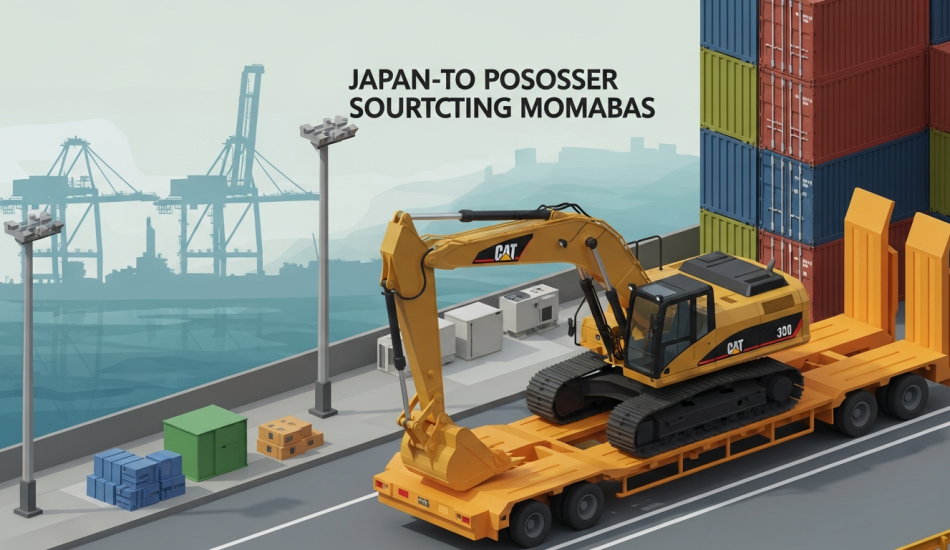
Once documentation is complete, the loader is containerized — most CAT 950 and 966 models ship in a 40HQ flat-rack or open-top container out of Nagoya or Osaka — and we coordinate with the freight forwarder to book the next available vessel to Melbourne, Brisbane, or Fremantle depending on your project location. We handle the Japanese export declaration on our side; your customs agent manages the Australian import entry, GST payment, and biosecurity inspection at the border.
Australian Import Regulations and Compliance
Australia’s Department of Agriculture requires all used machinery to undergo biosecurity inspection at the port of entry. Machines must be clean of soil, plant material, and organic residue before arrival — we enforce this during pre-shipment preparation in Japan, but it’s worth confirming your Australian broker books a biosecurity inspection slot ahead of vessel arrival to avoid demurrage charges. DIBP import duties for used construction equipment typically sit at 5% plus GST, though buyers registered for GST can reclaim that portion.
Shipping & Freight: Timeline and Costs
Japan-to-Australia transit time runs 12–18 days on most direct services. Allow an additional 5–7 business days for customs and quarantine clearance once the vessel berths. Freight and container costs to Australian east-coast ports typically range AUD 4,000–7,500 for a wheel loader, depending on the machine’s dimensions and current vessel rates — we quote this precisely after confirming the machine and container type, so there are no surprises when the final invoice lands.
One clearance delay we’ve seen repeatedly: machines that pass Japanese inspection but arrive with trace soil in the undercarriage cavity. Australian biosecurity officers flag this immediately and quarantine the unit for cleaning at the importer’s cost — sometimes AUD 1,500–3,000 and a week’s delay. We pressure-wash and photograph all machines before loading, but flag this risk to every buyer so they budget for it if border inspectors require additional treatment.
Frequently Asked Questions
How long does it take to import a used Caterpillar loader to Australia?
Typically 6–10 weeks from machine selection to Australian port delivery. That window covers pre-shipment inspection and documentation (1–2 weeks), vessel booking and transit from Japan (3–5 weeks), and customs plus quarantine clearance in Australia (1–2 weeks). Vessel schedules are the biggest variable — we quote estimated ETAs before you commit.
What paperwork do I need to import used heavy machinery into Australia?
You’ll need a commercial invoice, bill of lading, pre-shipment inspection certificate, and a customs entry declaration. Some machinery requires a formal import permit. We prepare the export side — Japanese customs export declaration, certificate of origin, and inspection report. Your Australian customs broker handles duty lodgement and quarantine clearance on arrival.
Are used Caterpillar loaders from Japan cheaper than buying locally in Australia?
Generally yes — by 15–30% even after freight, customs duty, and GST. A CAT 966H sourced from Japan typically lands in the AUD $85,000–$130,000 range depending on hours and condition, compared to equivalent local dealer stock often priced well above that. Exact savings depend on machine age and current shipping costs.
How is a used CAT loader inspected before it ships from Japan?
We run a full pre-shipment inspection covering engine performance, hydraulic system pressure and response, undercarriage or tyre wear, structural integrity, and cab condition. Every inspection produces a detailed written report with timestamped photographs. You receive the report before you release payment — no surprises after the machine ships.
Can I get equipment financing for an imported Caterpillar wheel loader?
Yes. Major Australian banks and specialist equipment finance companies regularly finance Japanese-sourced used machinery. We provide a full documentation package — inspection certificate, commercial invoice, and specification sheet — to support your finance application. Contact us early in the process; lenders typically want documentation confirmed before approving drawdowns on imported stock.
Important: Import regulations, freight costs, emissions rules, and customs requirements can change. Always confirm current rules with a licensed customs broker, freight forwarder, and relevant authorities before purchase.
Conclusion
Sourcing a used Caterpillar wheel loader from Japan — a 966F, 950H, or 936 — puts you 15–30% below what a local dealer typically quotes for comparable hours and vintage, without sacrificing documented condition. JapanMachineryTrader handles sourcing, pre-shipment inspection, export paperwork, and freight forwarding to the Australian port of your choice. The machine you receive is the machine that was inspected — no surprises on the wharf, no scramble through customs documentation you’ve never seen before.
Browse current CAT loader listings on the site and request a detailed inspection report and landed-cost estimate for the model that fits your spec. If you haven’t locked down the right configuration yet, contact the team directly — we’ll work through bucket size, engine hours, and delivery timeline before you commit to anything.
Ready to source your next Caterpillar loader from Japan?
View our current inventory of CAT 966, 950, and 936 models, or contact us directly with your specifications. We’ll provide a detailed inspection report and locked pricing within 48 hours.
View listings →