 JapanMachineryTrader
 AB used Komatsu PC200 that sold for $68,000 at a Nagoya auction in early 2024 — 2017 2build, 5,200 hours, full service history — would retail for north of $120,000 in comparable condition from an Australian dealer. That gap is why construction contractors and equipment dealers across Kenya, Indonesia, the Philippines, and the US keep coming back to Japan for their excavator sourcing.
This guide will walk you through which used Komatsu excavator models suit which job sites, what realistic FOB pricing looks like by model class and hour range, how to verify condition before committing capital, and what shipping and import duties actually cost in your target market.
WeD cover the three main Komatsu classes — PC120, PC200, and PC360 — with current price ranges tied to real hour and year brackets. We explain what a credible pre-shipment inspection report should include and flag the documentation gaps that cause clearance delays in Nigeria, Australia, and the US. Freight cost breakdowns by destination and container type follow, along with a total cost-of-ownership comparison against new equipment. By the end, you’ll have enough to shortlist a model, set a realistic budget, and ask the right questions before you wire a deposit.
Get Transparent Pricing on Used Komatsu Excavators
Sourcing the right used excavator requires accurate pricing, condition details, and realistic shipping timelines for your destination. Share your project specs—model preference, budget, and target country—and receive a detailed quote from our team within 24 hours.
Request a quote →
Why Buy Used Komatsu Excavators from Japan?
Komatsu builds its excavators at Japanese factories under JIS-certified quality controls, and the domestic market reinforces that. Japanese contractors service equipment on schedule, use genuine Komatsu parts, and trade machines well before they’re worn out. A unit coming off a Tokyo rental fleet at 3,500 hours is genuinely different from a 3,500-hour machine that spent five years on a remote Australian mining site with irregular filter changes.
The cost gap is real and persistent. A used Komatsu excavator sourced from Japan typically runs 30–50% below equivalent-condition stock in North America or Australia, even after you factor in ocean freight and destination duties. That spread holds across classes — from the PC120 compact up through the PC360 — which is why dealers in Kenya, Nigeria, Indonesia, and the Philippines keep coming back to Japanese supply rather than buying locally.
Japan Machinery Trader pulls inventory directly from Japanese auction houses and rental fleet liquidations, so the unit history is traceable. Every machine we export ships with a certified pre-shipment inspection report, giving overseas buyers documented evidence of hydraulic function, undercarriage condition, and engine health before a single dollar clears.
Auction-grade reports in Japan (AAA through B-grade) are a useful starting point, but they’re not substitutes for a hands-on inspection. We’ve seen B-grade units that were cosmetic-only downgrades and A-grade units with undisclosed hydraulic leaks. Always request an independent walk-around, not just the auction sheet.
Used Komatsu Excavator Models & Price Ranges
Komatsu’s excavator lineup breaks into three practical tiers for buyers sourcing from Japan. The PC120 (12-ton class) handles compact urban and residential sites — typical FOB pricing runs $25,000–$40,000 for units built 2014–2019 with 3,000–6,000 hours. The PC200 (20-ton class) is the most-traded model on the Japanese market, covering general earthmoving and foundation work at $40,000–$80,000 FOB Yokohama, depending on year and hours. Larger PC360 units for major earthworks and mining preparation command $80,000–$180,000 FOB.
Pricing moves sharply with operating hours. A 2016 PC200-8M0 with 4,500 hours might clear a Japanese auction at ¥5.2–¥6.8 million (roughly $34,000–$45,000), while a comparable unit at 7,500 hours typically drops 20–30% in hammer price. Our sourcing team monitors Japan Auto Auction (JAA) and dealer fleet releases weekly, so the figures we quote reflect live market conditions — not catalog estimates. Request a current price list for your target model and destination country.
Not Sure Which Komatsu Model Fits Your Project?
Our machinery sourcing specialists can recommend the right excavator class (PC120, PC200, or PC360) based on your site size, timeline, and budget. We’ll also walk you through import requirements and financing options specific to your country.
Talk to our team →
How to Verify a Used Komatsu Excavator’s Condition
Operating hours are the first number to anchor on. Under 3,000 hours on a 2015–2019 unit is genuinely low-use — equivalent to a late-model vehicle with modest mileage. Units in the 4,000–7,000-hour range are standard and still serviceable, but inspect them harder. Anything north of 8,000 hours demands a clear maintenance record and a compelling price to justify the risk.
Physical condition tells a story the hour meter can’t. Request a Komatsu KOMTRAX readout or a third-party CAT scanner diagnostic to surface active fault codes in the engine and hydraulic ECU before you commit. On the mechanical side, examine boom and arm cylinder seals for oil weeping, check bucket teeth and adapter plates for uneven wear, and press both hands against the undercarriage track links — excessive lateral play there means a rebuild is coming soon.
Flood history is the one condition we flag as a deal-breaker without exception. Salt-water or submersion exposure corrodes wiring harnesses in ways that don’t show up on a visual inspection until months after arrival.
- Operating hours: <3,000 hrs (excellent), 3,000–7,000 hrs (standard), >8,000 hrs (inspect carefully)
- Request KOMTRAX or CAT scanner report — confirm zero active fault codes
- Check boom/arm cylinder seals, bucket teeth, and undercarriage track tension
- Verify no flood, submersion, or salt-water exposure in unit history
We’ve seen buyers overlook hairline cracks in the swing bearing ring on otherwise clean units — it’s a USD 4,000–8,000 repair that a five-minute visual with the machine rotating under load would have caught. Always run the machine through a full swing cycle during pre-shipment inspection, not just a static check.
Export & Shipping Costs: US, Australia, Kenya, Nigeria, Indonesia, Philippines
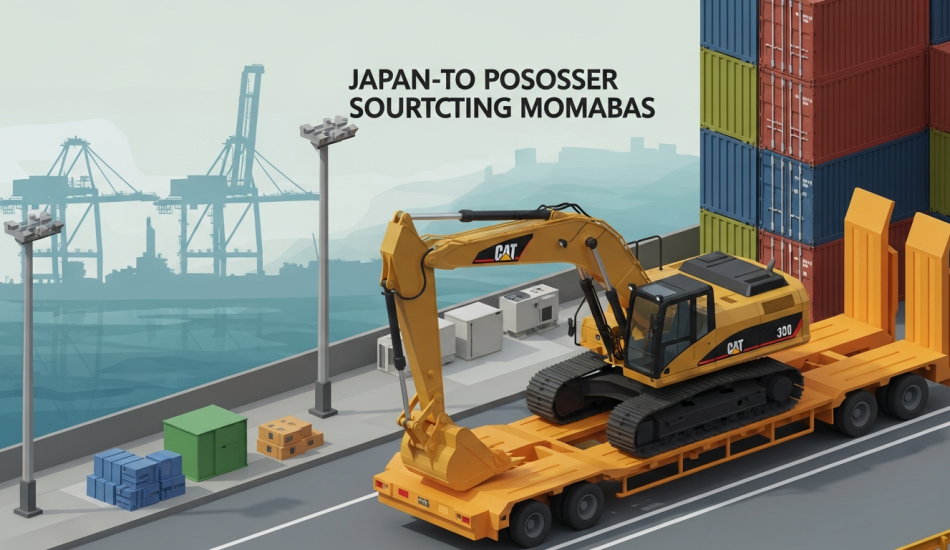
Shipping a used Komatsu excavator from Japan to your destination port runs $3,500–$8,000 for a 20ft container on most lanes we regularly book — East Africa (Mombasa), Southeast Asia (Manila, Surabaya), West Africa (Lagos), and Oceania (Sydney, Melbourne). A 40HQ, which fits a PC200 or PC360 with attachments, typically adds $1,500–$2,500 over the 20ft rate depending on the lane and season.
Transit times vary by destination: Indonesia and the Philippines generally clear in 10–18 days from Yokohama or Osaka; Kenya and Nigeria run 25–35 days; Australia sits around 14–21 days; and US West Coast ports (LA/Long Beach) average 18–25 days. Budget an additional 5–10 days for port clearance and inland delivery.
Shipping Costs by Destination: 20ft/40ft Container Breakeven
A single PC120 ships comfortably in a 20ft container, making that unit size the cost-efficient choice for smaller budgets. Once you’re buying a PC200 or larger, the 40HQ rate almost always makes more sense — you can consolidate a PC200 with a spare bucket set or hydraulic hammer and still come in under the per-unit shipping cost of booking two separate 20ft boxes.
Import Taxes & Duties by Country
Duty rates differ sharply by market. Kenya charges 25% import duty plus 16% VAT on CIF value; Nigeria applies a 5–35% surcharge depending on HS code classification and the current ECOWAS tariff schedule. Indonesia imposes roughly 5–10% import duty on construction machinery (HS 8429/8430), while the Philippines typically runs 0–5% under ASEAN trade agreements. Australia requires biosecurity cleaning to DAFF standards — budget AUD 500–1,200 per machine. US importers must confirm EPA Tier compliance; pre-2004 engines generally clear under the 21-year exemption, but verify your specific serial number before booking freight.
One detail that catches buyers off guard: Nigerian port demurrage at Apapa or Tin Can accumulates fast — we’ve seen buyers absorb $3,000+ in extra charges simply because their customs agent wasn’t ready on arrival. Pre-clear your documentation before the vessel departs Japan, not after.
Frequently Asked Questions
What does a used Komatsu PC200 excavator from Japan typically cost?
A 2015–2018 PC200 with 4,000–6,000 operating hours runs $45,000–$70,000 FOB Japan depending on condition and spec. Budget an additional 15–25% for ocean freight, destination port handling, and import duties. Units under 5,000 hours in good undercarriage condition sell fastest — availability shifts quarterly.
How do I confirm a Komatsu excavator’s condition before it ships from Japan?
Request the CAT scanner diagnostic report, pre-shipment inspection photos, and hydraulic function test results. Japan Machinery Trader includes a certified inspection report with every quote — covering boom/arm cylinders, undercarriage wear, and engine fault codes. If a seller can’t produce diagnostics, walk away.
Which Komatsu excavator model suits a tight budget and confined job site?
The PC120 (12-ton class) is the practical choice. Priced at $25,000–$40,000 used, it handles residential foundation work and urban utility projects where a 20-ton unit can’t maneuver. Fuel consumption runs roughly 20–30% lower than a PC200, which matters on long projects.
How long does shipping take from Japan to Kenya, Nigeria, Indonesia, or Australia?
Ocean freight typically takes 3–6 weeks port-to-port. East Africa (Mombasa) runs 4–5 weeks; Southeast Asia (Jakarta, Manila) closer to 3 weeks; Australia 2–4 weeks. Customs clearance adds time — budget an extra 1–2 weeks depending on your country’s documentation requirements.
Can I get financing for a used Komatsu excavator imported from Japan?
Yes — many equipment lenders finance Japanese imports, but they’ll require a pre-shipment inspection report and proof of marine insurance. Deals under $100,000 FOB are generally easier to place. Engage your lender before finalizing the purchase order so inspection documentation is ready when they need it.
Important: Import regulations, freight costs, emissions rules, and customs requirements can change. Always confirm current rules with a licensed customs broker, freight forwarder, and relevant authorities before purchase.
Conclusion
Used Komatsu excavators from Japan — the PC120, PC200, and PC360 — represent a proven value proposition for contractors and dealers in markets from Nairobi to Manila: factory-disciplined maintenance history, certified pre-shipment inspection, and pricing 30–50% below equivalent North American or Australian stock. The risks are real but manageable when you verify hours, demand a diagnostic report, and work with an exporter who handles customs documentation for your specific destination country. Price, condition, and freight costs are knowable before you commit a dollar.
Contact Japan Machinery Trader with your target model, operating-hour range, budget, and destination country. We’ll return a detailed quote — FOB price, freight estimate, and country-specific duty breakdown — within 24 hours, along with the pre-shipment inspection report for any unit you’re seriously considering.
Ready to Import? Get Your Pre-Shipment Inspection Report
Once you’ve selected your unit, we handle certified inspection, export documentation, and freight forwarding to your destination. Contact us to finalize your order and receive a detailed condition report before payment.
Contact us →