 JapanMachineryTrader
 A used Komatsu excavator shipped from Japan still outworks a lot of new iron elsewhere — and at 40–50% below equivalent new-equipment pricing in the US, Australia, or East Africa, the math is hard to ignore for any contractor running tight project margins.
By the end of this page, you’ll know which Komatsu model fits your site and budget, what realistic FOB pricing looks like for PC120, PC200, and PC360 units, and what Japan Machinery Trader does between sourcing and your port to keep the transaction clean.
We’ll cover model-by-model specs and current market rates drawn from Japanese auction activity, the inspection process that separates a sound machine from an expensive mistake, and destination-specific freight and duty estimates for buyers in Kenya, Nigeria, Indonesia, the Philippines, Australia, and the US. There’s also a section on total cost of ownership that puts the used-versus-new decision in dollar terms — because ‘cheaper upfront’ only wins if the machine actually runs. If you’re ready to move now, request a quote with your target model, operating hours, and destination country and our sourcing team will respond within 24 hours.
Get a transparent quote on used Komatsu excavators in 24 hours
Tell us the model, operating hours, and your destination—we’ll send pricing, shipping costs, and import timeline estimates tailored to your market and budget.
Request a quote →
Why Buy Used Komatsu Excavators from Japan?
Japan runs some of the most disciplined equipment maintenance regimes in the world. Komatsu machines coming out of Japanese rental fleets and construction sites routinely log 3,000–5,000 hours over five to seven years — figures that would be 7,000–10,000 hours on equivalent North American or Australian stock. The factory tolerances Komatsu builds into every unit at its Oyama and Ibaraki plants hold up precisely because Japanese operators follow service intervals without skipping them.
Buying a used Komatsu excavator through Japan Machinery Trader means you’re not guessing at history. We source directly from domestic auctions — including Japan Auto Appraisal Institute (JAAI) listings and major dealer fleet turnovers — and every unit we quote ships with a certified pre-shipment inspection report, photographic documentation of the undercarriage and hydraulics, and full export paperwork. That paper trail matters when your bank or broker needs to release funds.
The cost differential is real: comparable condition machines from Japan typically land 30–50% below equivalent stock priced locally in the US or Australia, even after ocean freight and import duties. That gap funds your next attachment, your first service kit, or simply stays in your working capital.
One thing buyers often overlook: Japanese auction grade sheets use a standardized A–E scale with sub-ratings for body, boom, and undercarriage. A unit graded 3.5 in Japan is not the same as a dealer calling something ‘good condition’ in Lagos. Always ask for the original auction sheet — we attach it to every quote.
Used Komatsu Excavator Models & Price Ranges
Komatsu’s excavator lineup breaks cleanly into three classes that account for the vast majority of what we source and ship. The PC120 (12-ton class) runs $25,000–$40,000 FOB Yokohama for units with 3,000–6,000 hours from 2014–2018. It suits compact urban sites, utility trenching, and tight residential work where a larger machine can’t maneuver. Fuel consumption averages 12–15 liters per hour, which matters on projects where fuel cost is a real budget line.
The PC200 is the most requested used Komatsu excavator we quote — and for good reason. At $40,000–$80,000 FOB, a 2015–2019 PC200-8 with 4,000–7,000 hours covers foundation work, road building, and general earthmoving without overpaying for capacity. Step up to the PC360 when the job demands serious reach and breakout force: pricing runs $80,000–$180,000 depending on year and hours, with later models commanding a premium because PC360-8 units from 2017 onward carry Tier 4 engine configurations that ease emissions compliance in US and Australian ports.
Not sure which Komatsu model fits your project?
Our sourcing specialists assess your site size, budget, and timeline to recommend the right excavator—and handle the entire export process from Japan to your door.
Talk to our team →
How to Verify a Used Komatsu Excavator’s Condition
Operating hours are the single most useful condition signal on any used Komatsu excavator. A unit manufactured between 2016 and 2019 with under 3,000 hours on the meter is considered low-wear — comparable to a late-model vehicle with 60,000 kilometers. Above 6,000 hours, factor in undercarriage replacement cost, which runs $8,000–$18,000 depending on shoe width and track frame condition.
Beyond the hour meter, verify the machine’s usage history. Units that worked coastal reclamation, port dredging, or flood-affected sites carry corrosion risk that photos rarely reveal. Request a CAT scanner diagnostic readout — Komatsu’s onboard KOMTRAX system can surface fault code history and idle-time ratios, giving a clearer picture of how the engine and hydraulic circuits were actually loaded.
Physical inspection points matter just as much as digital records. Examine bucket teeth for uneven wear, check boom and arm cylinder seals for weeping hydraulic fluid, and assess undercarriage sprockets and track rollers for play. Worn rollers and cracked carrier links are the repair items that quietly erode a bargain.
- Hour meter: under 3,000 hrs on a 5–8 year old unit is excellent; over 6,000 hrs warrants undercarriage cost assessment
- Flood/salt exposure: review work history and check frame welds for rust blistering
- KOMTRAX / CAT scanner: confirm no active fault codes on engine, hydraulic pump, or swing motor circuits
- Undercarriage: inspect sprockets, rollers, idlers, and track shoe thickness — these drive post-purchase repair budgets
- Cylinders & seals: hydraulic fluid weeping at boom/arm pins signals imminent seal replacement
We’ve seen units with suspiciously round hour-meter readings — 2,000 or 4,000 exactly — that turned out to have had their ECM replaced or reset. Cross-check the KOMTRAX telematics data against the physical wear on the undercarriage; if the numbers don’t align, walk away or discount hard.
Export & Shipping Costs: US, Australia, Kenya, Nigeria, Indonesia, Philippines
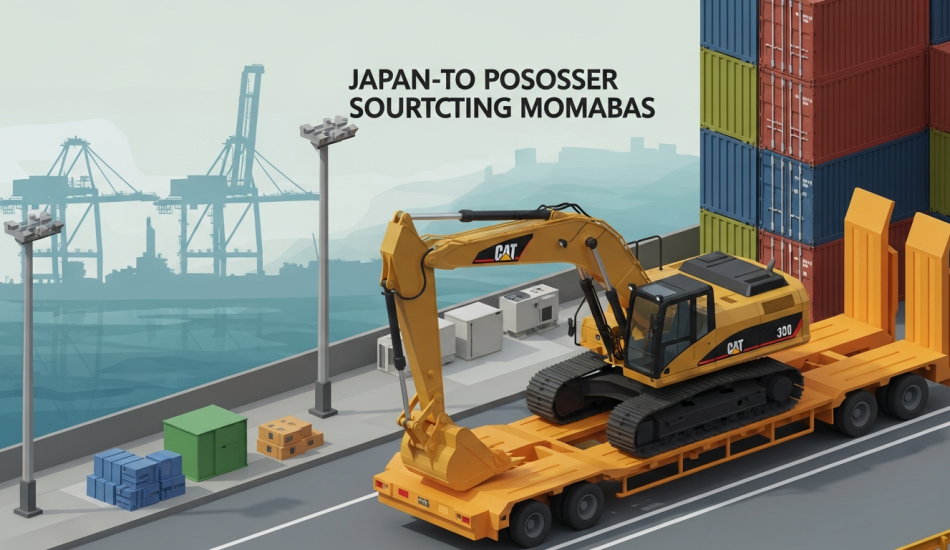
Ocean freight from Japan to your destination port typically runs $3,500–$6,500 for a 20ft container and $5,500–$9,500 for a 40ft, depending on the routing and season. A single Komatsu PC120 ships comfortably in a 20ft; a PC200 or PC360 usually requires a 40ft high-cube or RORO booking. Transit times range from 18–22 days to Southeast Asia and Australia, 25–35 days to East Africa, and 28–42 days to West Africa or the US Gulf Coast.
Import duties and compliance costs add meaningfully to the landed price. Kenya charges 25% import duty plus 16% VAT on used excavators; Nigeria applies a 5–10% duty under the ECOWAS CET but adds a 1% CISS fee and port surcharges. Indonesia and the Philippines typically levy 5–10% tariff plus local VAT, while Australia requires biosecurity fumigation (around AUD 800–1,200) and compliance with state registration rules. US importers face minimal tariff on construction machinery but must confirm EPA Tier compliance for federally funded jobsites.
Shipping Costs by Destination: 20ft/40ft Container Breakeven
For a single used Komatsu excavator in the PC120 class, a 20ft container is the cost-efficient choice — breakeven against a 40ft occurs when you’re shipping two or more units or adding attachments. Groupage or LCL bookings rarely make sense for heavy iron; the handling risk and delay exposure outweigh the freight savings.
Import Taxes & Duties by Country
Duty rates shift frequently, and some markets — particularly Nigeria and Indonesia — impose additional port-handling or scanning fees that don’t appear in published tariff schedules. We include a country-specific landed-cost estimate with every quote so buyers can model total acquisition cost before committing.
RORO is occasionally cheaper than container for larger machines like a PC360, but it exposes the unit to weather and deck movement — we’ve seen hydraulic line chafing on RORO shipments that would have been avoided in a sealed 40ft. For high-value units, container is worth the premium.
Frequently Asked Questions
What does a used Komatsu PC200 excavator from Japan actually cost, landed?
FOB Japan, a 2015–2018 PC200 with 4,000–6,000 hours typically runs $45,000–$70,000 depending on condition and spec. Add $8,000–$15,000 for ocean freight plus destination duties — figure 15–25% on top of FOB. We include itemized landed-cost estimates with every quote.
How do I confirm a used Komatsu excavator was well maintained before I wire any money?
Request the CAT scanner diagnostic report (no active fault codes), pre-shipment inspection photos covering hydraulic function, boom/arm travel, and undercarriage wear, and the maintenance log where available. Japan Machinery Trader provides a certified inspection report with every unit — not just photos, but documented test results.
Which Komatsu excavator model suits a tight urban job site on a limited budget?
The PC120 (12-ton class, roughly 18–22 ft reach) is the right call. It fits confined residential and utility sites, burns less fuel than larger machines, and typically costs $25,000–$40,000 used from Japan — about half what equivalent local dealer stock commands in most markets.
How long does shipping from Japan take, and what does it cost?
Ocean freight typically runs 3–6 weeks port-to-port depending on destination — Kenya and Nigeria sit toward the longer end; Australia and Southeast Asia closer to three. A 20ft container carrying one mid-size excavator costs roughly $8,000–$15,000 all-in freight. We provide destination-specific estimates with each quote request.
Can I get financing on a used Komatsu excavator imported from Japan?
Yes — many equipment lenders finance Japanese imports, but they typically require a pre-shipment inspection report and proof of marine insurance before approving. Deals under $100,000 FOB are generally easier to place. Talk to your lender early; we can supply the documentation they need at the inspection stage.
Important: Import regulations, freight costs, emissions rules, and customs requirements can change. Always confirm current rules with a licensed customs broker, freight forwarder, and relevant authorities before purchase.
Conclusion
A used Komatsu excavator sourced from Japan — properly inspected, correctly documented, and shipped on the right INCOTERM — lands at 40–50% below the cost of equivalent new iron in most markets. The PC120, PC200, and PC360 each serve a distinct job-site tier, and the pricing data bears that out. What separates a clean transaction from a costly mistake is pre-shipment inspection, country-specific customs knowledge, and a freight partner who’s handled your destination port before.
Ready to move forward? Contact the Japan Machinery Trader team with your target model, acceptable hour range, and destination country. We’ll return a detailed quote — FOB Japan price, estimated freight, and applicable import duties — within 24 hours, along with the pre-shipment inspection report for any unit you’re considering.
Ready to import a pre-inspected Komatsu excavator?
Contact us with your target model and destination. We’ll provide a detailed pre-shipment inspection report, finalized pricing, and country-specific import guidance to close the deal.
Get in touch →