 JapanMachineryTrader
A used CAT 320 sitting in a Japanese yard today can land on an Australian worksite in six to eight weeks — at a total cost that routinely undercuts equivalent second-hand stock from Sydney or Melbourne dealers by 20–35%. That gap exists because the pipeline for used Caterpillar excavator export from Japan to Australia is well-worn but poorly documented.
By the end of this page, you’ll know which Cat models are available from Japanese stock, what the full landed cost looks like broken down line by line, what Australian customs and biosecurity actually require, and how to move from inquiry to delivery without the guesswork.
We’ll cover the most in-demand Caterpillar models — CAT 320, 330, 336, and 349 — with real price ranges from current inventory, a step-by-step breakdown of the Japan-to-Australia shipping process, and a plain-language walkthrough of Australian import requirements including HS code 8429.51 tariff classification, biosecurity clearance, and RHS compliance. Payment terms, pre-shipment inspection standards, and financing options are covered too, because landed cost and machine condition are the two questions every serious buyer asks first.
Find Your Used Caterpillar Excavator from Japan Today
Australian construction contractors and equipment dealers trust Japan Machinery Trader for inspected, competitively-priced used Cat excavators with full export documentation and freight support. Get a transparent quote tailored to your budget and timeline.
Request a quote →
Why Import Used Caterpillar Excavators from Japan to Australia
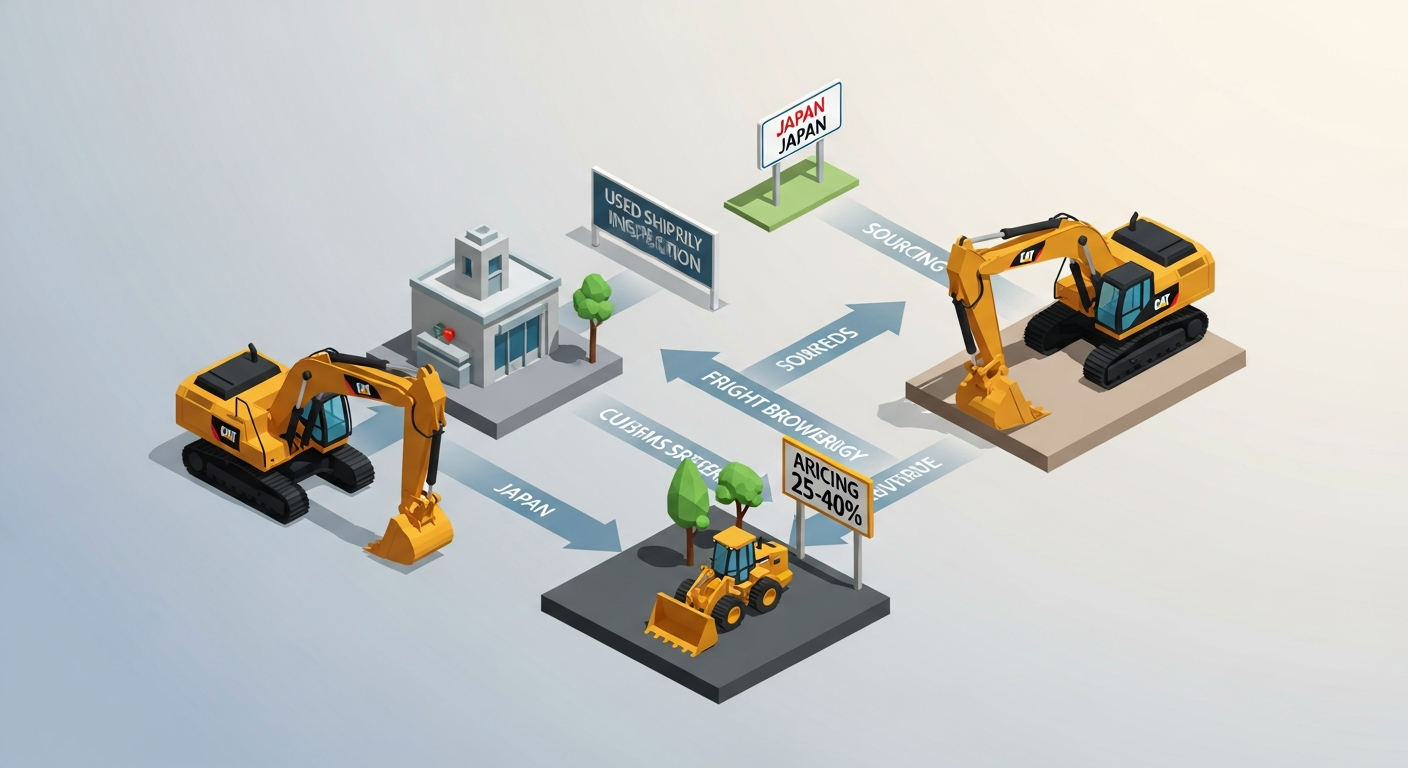
The price gap between Japan-sourced used Caterpillar excavators and comparable machines on Australia’s second-hand market runs 25–40% in favour of Japan, based on our Q4 2024 inventory and comparable listings on Australian plant machinery exchanges. A CAT 320 with 4,000–6,000 hours that lists at AUD 55,000–70,000 through a domestic dealer regularly moves for USD 22,000–28,000 FOB Yokohama — landed in Melbourne at AUD 42,000–52,000 all-in, including freight, duty, and documentation.
Japanese Caterpillar units also tend to arrive in better shape than their age suggests. Strict domestic vehicle inspection regimes, shorter average operating cycles, and the fact that many machines come out of civil engineering or rental fleets with documented service histories mean you routinely find sub-5,000-hour examples that would be rare on the Australian second-hand market at the same price point.
Caterpillar’s global parts network is another practical advantage — Cat dealers across Queensland, NSW, and WA stock compatible components for the 320, 330, and 336 series, so post-import maintenance doesn’t depend on sourcing parts internationally. For Australian contractors weighing a used Caterpillar excavator export from Japan, that parts confidence meaningfully reduces operational risk.
One detail buyers often overlook: specific configurations common in Japan — such as the CAT 320 short-radius variant used on tight urban sites — rarely surface through Australian dealers. If your project needs that spec, Japan is often the only practical source.
Popular Caterpillar Excavator Models Available for Australian Export
Japan’s used-equipment market consistently stocks a wide range of Caterpillar excavators suited to Australian civil, mining, and commercial construction work. The most common classes we source—20-ton, 30-ton, and 35-ton—align directly with what Australian contractors pull off trailers on job sites from Queensland earthworks to Victorian road projects.
Australian buyers typically ask first about operating hours. Machines we ship are generally in the 3,000–8,000-hour range, with well-serviced units from Japanese construction fleets often sitting toward the lower end of that band. Hour meters are verified during pre-shipment inspection, and service records—where available—are included in the condition report.
CAT 320 and CAT 330 Mini and Mid-Range Excavators
The CAT 320 is the single most requested model in our Australian inquiries. At roughly USD 20,000–35,000 ex-Japan, it covers general excavation, utility trenching, and site preparation where a 20-ton machine is the practical ceiling. The CAT 330 steps up to approximately 30 tonnes operating weight, with a larger bucket capacity and stronger lift ratings—better suited to bulk earthmoving and infrastructure contracts where the 320 would be working at its limit.
CAT 336 and CAT 349 Large Excavators for Heavy-Duty Projects
For mining-support work, large civil earthmoving, or quarry operations, the CAT 336 and CAT 349 are the units to evaluate. The 336 sits in the 36-tonne class; the 349 pushes past 48 tonnes with a heavier undercarriage and higher hydraulic output. Both models are well-represented in Japan’s used-machine pipeline, and their Caterpillar parts network reach across Australia makes ongoing maintenance straightforward compared to less common brands.
One detail buyers often miss: Japanese construction fleets tend to run shorter annual hours than Australian mine-site machines, so a 6,000-hour CAT 320 from Japan frequently shows less structural fatigue than a same-hour machine from a domestic Australian rental fleet. That gap matters when you’re pricing undercarriage replacement at the next 2,000-hour service.
Calculate Your Total Landed Cost—Freight, Tariff & Inspection Included
Most buyers underestimate import expenses. We break down machine price, inspection, shipping to Australia, and tariff in one transparent estimate. Talk to our team to see exactly what your Cat excavator will cost landed in your state.
Get cost estimate →
Cost Breakdown: Pricing, Tariffs & Total Import Expense
A used CAT 320 from Japan typically lists at USD 20,000–35,000 depending on operating hours and condition grade; a CAT 330 runs USD 30,000–50,000, and a CAT 336 can reach USD 55,000–80,000 for clean, lower-hour examples. These are ex-Japan prices — your total landed cost in Australia runs 20–30% higher once you add the downstream expenses.
Pre-shipment inspection adds roughly USD 500–1,000. Sea freight from Yokohama or Kobe to Melbourne or Sydney ran USD 4,000–6,000 per unit on RoRo or flat-rack in Q4 2024, plus port handling at the Australian end. Australia levies a 5% import tariff on used excavators classified under HS code 8429.51, applied to the customs value (CIF). Documentation and customs brokerage typically add USD 300–600.
For a mid-range CAT 320 export Australia buyers can budget roughly AUD 48,000–65,000 landed — machine, freight, tariff, inspection, and docs combined. Request a line-item quote before committing; the numbers shift with exchange rates and cargo routing.
- Machine (CAT 320): USD 20,000–35,000
- Machine (CAT 330): USD 30,000–50,000
- Pre-shipment inspection: USD 500–1,000
- Sea freight (Japan → Melbourne/Sydney): USD 4,000–6,000
- Australian import tariff (HS 8429.51): 5% on CIF value
- Documentation and customs brokerage: USD 300–600
Exchange rate timing matters more than buyers expect. A AUD/USD swing of 5 cents between deposit and balance payment can shift your landed cost by AUD 1,500–2,500 on a single machine. Lock your FX rate or account for the variance in your budget from day one.
Australian Import Requirements and Regulations
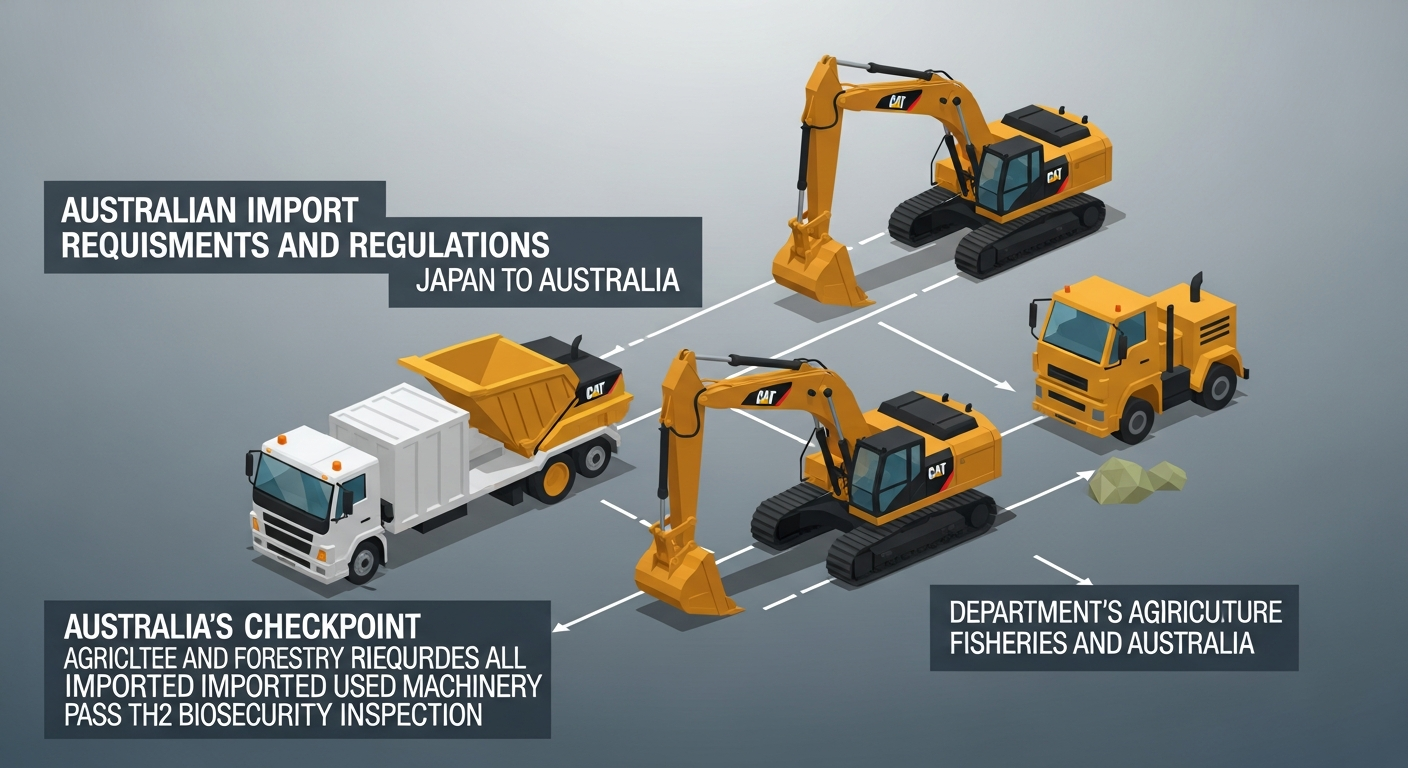
Australia’s biosecurity rules are the first real checkpoint for any used Caterpillar excavator export from Japan. The Department of Agriculture, Fisheries and Forestry requires all imported used machinery to pass a biosecurity inspection on arrival — machines must be free of soil, plant material, and biological contamination. Your Australian customs broker will lodge the import declaration and arrange inspection at the port; failing biosecurity means a mandatory wash-down or, in serious cases, re-export at your cost.
On the tariff side, excavators clear under HS code 8429.51, which currently attracts a 5% import duty on the customs value (machine price plus freight and insurance) — verify the current rate against the Australian Border Force tariff schedule before committing, as duty rates can be revised. Add GST at 10% on the landed value, and you have your full tax obligation. Documentation required includes the original Bill of Lading, commercial invoice, packing list, and certificate of origin confirming Japanese manufacture.
Caterpillar excavators carry no specific pre-import certification requirement in Australia, but the machine must be in safe operating condition — effectively roadworthy-equivalent — to satisfy workplace health and safety obligations under the relevant state WHS legislation once on site. RHS Heavy Vehicle Standard compliance applies primarily to road-registered vehicles; off-road construction excavators are exempt from RHS registration but still subject to state-level plant registration requirements depending on jurisdiction.
- Biosecurity clearance: soil and debris-free inspection at Melbourne, Sydney, or Brisbane port
- Tariff: 5% duty under HS 8429.51 on CIF value, plus 10% GST
- Required docs: Bill of Lading, commercial invoice, packing list, certificate of origin
- No Cat-specific pre-import certification, but state plant registration may apply post-import
Biosecurity is where deals get expensive fast. We’ve seen a 40HQ arrive at Melbourne with packed undercarriage mud that sailed through pre-shipment but triggered a full decontamination order dockside — AUD 1,800 and a four-day delay. A thorough steam clean in Japan before loading is cheap insurance; build it into the inspection scope, not an afterthought.
Frequently Asked Questions
What does a used Caterpillar 320 excavator cost landed in Australia?
A used CAT 320 from Japan typically runs USD 20,000–35,000 depending on operating hours and condition. Add USD 4,000–6,000 sea freight, 5% import tariff, USD 500–1,000 pre-shipment inspection, and documentation fees. Total landed cost in AUD generally falls between AUD 40,000–65,000 at current exchange rates.
How long does it take to ship a used Cat excavator from Japan to Australia?
Sea freight from Yokohama or Kobe to Melbourne or Sydney runs 3–4 weeks. Factor in 2–3 weeks for sourcing, inspection, and documentation. Most Australian buyers receive their machine 6–8 weeks from initial order confirmation — assuming no delays at biosecurity clearance.
Do I need permits or certifications to import a used excavator into Australia?
No pre-import machine certification is required for excavators used off-road on construction sites. However, you must clear Australian Biosecurity inspection, provide a Bill of Lading and Certificate of Origin, and correctly classify the machine under HS code 8429.51 for customs. A licensed Australian customs broker handles this efficiently.
What does JapanMachineryTrader’s pre-shipment inspection actually cover?
Every CAT excavator we export goes through engine compression testing, hydraulic pressure checks, boom and bucket structural assessment, undercarriage wear measurement, and a full operational run. You receive a written condition report with photos before we ship — so there are no surprises when the machine arrives at port.
Can I finance the purchase of a used Caterpillar excavator imported from Japan?
Yes. We support flexible payment structures — typically 30–50% T/T deposit with the balance settled against the Bill of Lading copy. We can also connect Australian buyers with equipment finance partners experienced in machinery imports. Contact our team to discuss options before committing to a model.
Important: Import regulations, freight costs, emissions rules, and customs requirements can change. Always confirm current rules with a licensed customs broker, freight forwarder, and relevant authorities before purchase.
Conclusion
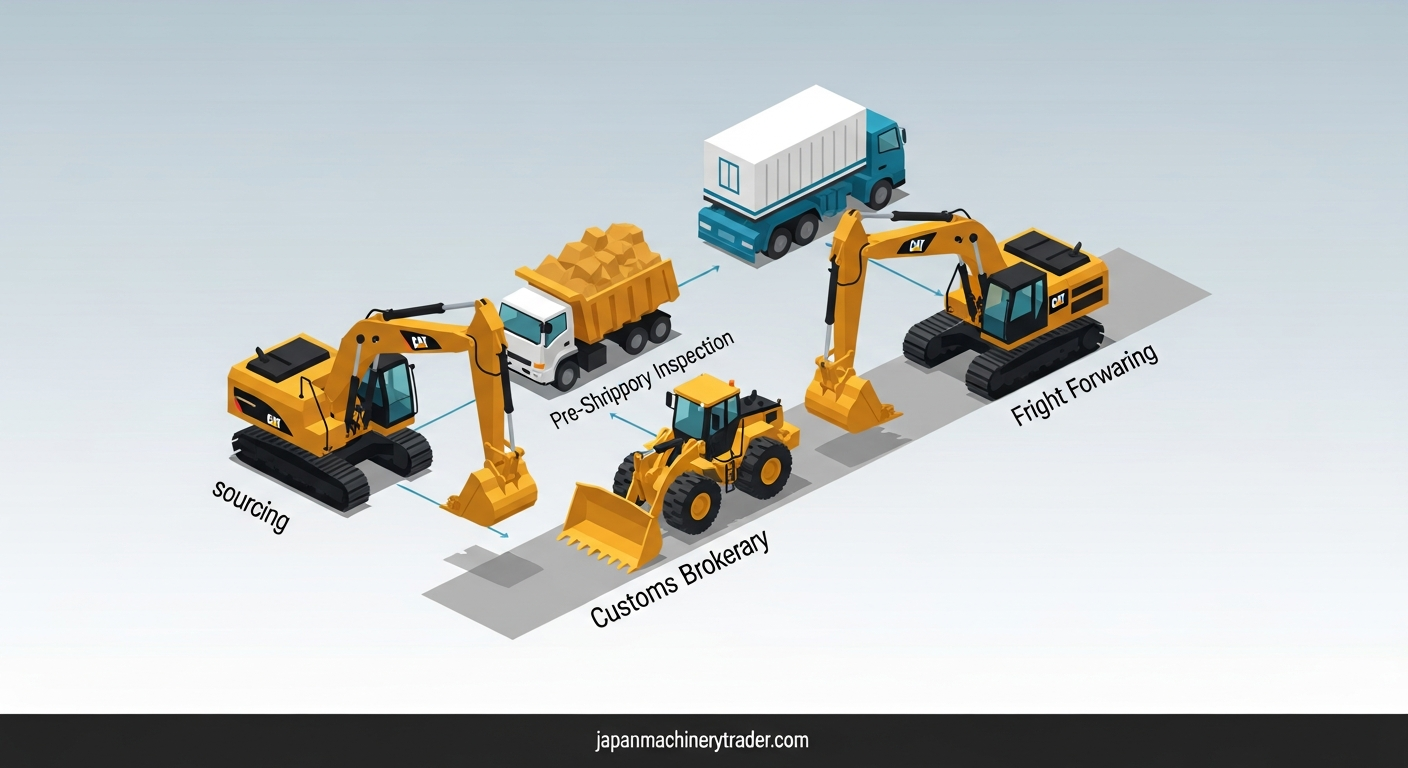
Sourcing a used Caterpillar excavator from Japan cuts landed costs significantly compared to buying locally in Australia — a CAT 320 typically arrives in Melbourne or Sydney for AUD 40,000–65,000 all-in, with a CAT 330 or 336 running proportionally higher depending on hours and spec. The machines are well-maintained, the parts supply chain is global, and the process — sourcing, inspection, documentation, freight, customs clearance — is manageable when you work with an exporter who handles the entire chain, not just the machine sale.
Request a quote directly from JapanMachineryTrader with the model, preferred operating-hour range, and target Australian port. Our team will respond with real inventory options, a pre-shipment inspection summary, and a full landed-cost breakdown — typically within one business day.
Ready to Import? Start Your Caterpillar Excavator Order Now
We handle sourcing, pre-shipment inspection, customs documentation, and freight coordination so you can focus on your projects. Reach out today and we’ll match you with the right machine for your fleet.
Contact our team →